| Trees | Indices | Help |
|
|---|
|
|
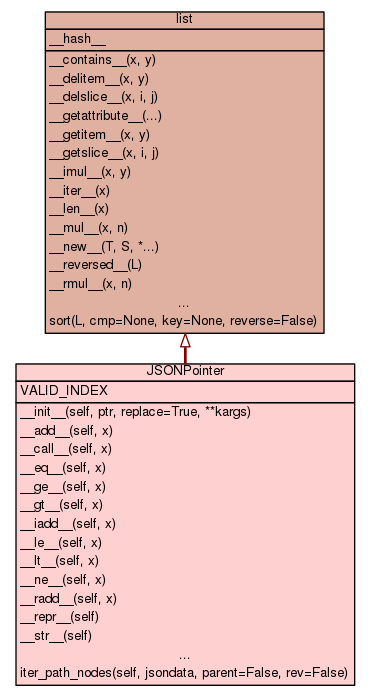
Represents exactly one JSONPointer in compliance with IETF RFC6901.
This pointer could be processed by extension, reduction, and general modification
with support of provided methods and path arithmetic operators.

The JSONPointer is provided at the API as a utf(-8) string in accordance
to RFC6901, including RFC3869.

For enhancement of the processing performance by the underlying packages
'json' and 'jsonschema', the pointer is stored and applied in two variants.

* self.raw: Raw input of the pointer string for the logical API.

* self.ptr: Split elements of the pointer path within a list of keys,
    for the programming interface.

The attribute 'self.ptr' contains the path elements in a
'list'::

   ptrlist := (<EMPTY>|plist)
   <EMPTY> := "empty list, represents the whole document"
   plist := pkey [, plist ]
   pkey := (''|int|keyname)
   '' := "the empty string is a valid key too"
   int := "integer index of an array item, just digits"
   keyname := "the valid name of an object/property entry"

The JSONPointer::

  "/address/0/streetName"

is represented as::

  ['address', 0, 'streetName' ]


The methods and operators are handling the pointer itself, the values
referenced by the pointer are not modified.

The methods of this class support for multiple input format of
the JSONPointer. The parameter 'x' in the operations is defined as a
valid JSONPointer fragment. A pointer fragment is a part of a pointer,
which could be the complete pointer itself - the all-fragment.

The syntax element could be one of::

    'str': A string i accordance to RFC6901. Strings are represented
        internally as unicode utf-8.

        Here either the input parameter 'x' is split into
        a list, or in case of combining operations, the self.ptr
        attribute is 'joined' to be used for the method.

    'int': A numeric value in case of an array index. This value
        is internally handled for the string representation as a
        unicode utf-8, whereas for the addressing of memory
        objects the numeric integer value is stored and applied.

    'JSONPointer': The attributes of the input object are used
        with it's peers.

    'list': Expects a path list containing:
        - JSON object names
            Names of the json objects.
        - array indexes
            Numeric index for arrays.
        - JSONPointer
            A JSONPointer object, the path is resolved as a section
            of overall path.

        The self.ptr attribute is applied for operations.

The node reference is cached by the 'get_node' and 'get_node_or_value'
method, thus could be accessed by 'self.node', but is not monitored
to be valid. Another call of the method reloads the cache by evaluating
the pointer value on the document again.

The provided value is internally stored as a raw input value, and a list
of keys and indexes for access to in-memory data as provided by the
packages 'json' and 'jsonschema'. Requests for the string representation
are transformed into a pointer path in accordance to RFC6901. This provides
for fast access in case of pointer arithmetics, while providing standards
conform path strings at the interface.
|
|||
| new empty list |
|
||
|
|||
|
|||
|
|||
|
|||
|
|||
|
|||
|
|||
|
|||
|
|||
|
|||
|
|||
|
|||
|
|||
|
|||
|
|||
|
|||
|
|||
|
|||
|
|||
|
|||
|
|||
|
|||
|
|||
|
|||
|
Inherited from Inherited from |
|||
|
|||
VALID_INDEX = re.compile(r'0Regular expression for valid numerical index. |
|||
|
Inherited from |
|||
|
|||
|
Inherited from |
|||
|
|||
Converts and stores a JSONPointer as a list.

Processes the ABNF of a JSON Pointer from RFC6901.

Args:
    ptr: A JSONPointer to be represented by this object. The
        supported formats are:
            'str': A string i accordance to RFC6901
            JSONPointer: A valid object, will be copied
                into this, see 'deep'.
            'list': expects a path list, where each item
                is processed for escape and unquote.
    replace: Replaces masked characters.
    **kargs:
        deep: Applies for copy operations on structured data
            'deep' when 'True', else 'swallow' only, which is
            just a link to the data structure. Flat data types
            are copied by value in any case.
        node: Force to set the pointed node in the internal cache.
        debug: Enable debugging.

Returns:
    When successful returns 'True', else returns either 'False', or
    raises an exception.
    Success is the complete addition only, thus one failure returns
    False.

Raises:
    JSONPointerException:
|
Appends a Pointer to self.

Args:
    x: A valid JSONPointer fragment.

Returns:
    A new object of JSONPointer

Raises:
    JSONPointerException:
|
Evaluates the pointed value from the document.

Args:
    x: A valid JSON document.

Returns:
    The pointed value, or None.

Raises:
    JSONPointerException
|
Compares this pointer with x.

Args:
    x: A valid Pointer.

Returns:
    True or False

Raises:
    JSONPointerException
|
Checks containment(>=) of another pointer within this.

The weight of contained entries is the criteria, though
the shorter is the bigger. This is true only in case of
a containment relation.

The number of equal path pointer items is compared.

Args:
    x: A valid Pointer.

Returns:
    True or False

Raises:
    JSONPointerException:
|
Checks containment(>) of another pointer or object within this.

The number of equal items is compared.

Args:
    x: A valid Pointer.

Returns:
    True or False

Raises:
    JSONPointerException:
|
Add in place x to self, appends a path.

Args:
    x: A valid Pointer.

Returns:
    'self' with updated pointer attributes

Raises:
    JSONPointerException:
|
Checks containment(<=) of this pointer within another.

The number of equal items is compared.

Args:
    x: A valid Pointer.

Returns:
    True or False

Raises:
    JSONPointerException:
|
Checks containment(<) of this pointer within another.

The number of equal items is compared.

Args:
    x: A valid Pointer.

Returns:
    True or False

Raises:
    JSONPointerException:
|
Compares this pointer with x.

Args:
    x: A valid Pointer.

Returns:
    True or False

Raises:
    JSONPointerException
|
Adds itself as the right-side-argument to the left.

This method appends 'self' to a path fragment on the left.
Therefore it adds the path separator on it's left side only.
The left side path fragment has to maintain to be in
accordance to RFC6901 by itself.

Once 'self' is added to the left side, it terminates it's
life cycle. Thus another simultaneous add operation is
handled by the resulting other element.

Args:
    x: A valid Pointer.

Returns:
    The updated input of type 'x' as 'x+S(x)'

Raises:
    JSONPointerException:
|
Returns the attribute self.raw, which is the raw input JSONPointer.
|
Returns the string for the processed path.
|
Checks the existance of the corresponding node within the JSON document.

Args:
    jsondata: A valid JSON data node.
    parent: Return the parent node of the pointed value.

Returns:
    True or False

Raises:
    JSONPointerException:
    forwarded from json
|
Returns a deep copy of the objects pointer path list.

Args:
    parent: The parent node of the pointer path.

Returns:
    A copy of the path list.

Raises:
    none
|
Gets the corresponding node reference for a JSON container type.

This method gets nodes of container types. Container
types of JSON are 'array' a.k.a. in Python 'list',
and 'objects' a.k.a. in Python 'dict'.

Due to the special case of RFC6902 'append' by the array
index '-' in combination of the add rules a special
exception-treatment is required, for details refer to RFC6902.

The 'get_node' method therefore returns only an existing
node of a of valid non-ambiguous path pointer. This
excludes pointers containing the symbolic index '-' for
an array component.

See also related methods:

    get_node_and_child: For Python access to a child node
        within a container by the container itself, and the
        item key.
    get_node_exist: For the application of partial valid
        pointer paths of new branches.
    get_node_or_value: For any type of pointed item, either
        a node, or a value.

Args:
    jsondata: A valid JSON data node.
    parent: Return the parent node of the pointed value.
        When parent is selected, the pointed child node
        is not verified.

Returns:
    The node reference.

Raises:
    JSONPointerException:
    forwarded from json
|
Returns a tuple containing the parent node and the child.

Args:
    jsondata: A valid JSON data node.

Returns:
    The the tuple:
    (n,c):  n: Node reference to parent container.
            c: Key for the child entry, either an
               index 'int', or a key ('str', 'unicode').
Raises:
    JSONPointerException:
    forwarded from json
|
Gets the corresponding node reference or the JSON value of a leaf.

Relies on the standard package 'json' by 'Bob Ippolito <bob@redivi.com>'.
This package supports in the current version the following types:

    +---------------+-------------------+
    | JSON          | Python            |
    +===============+===================+
    | object        | dict              |
    +---------------+-------------------+
    | array         | list              |
    +---------------+-------------------+
    | string        | unicode           |
    +---------------+-------------------+
    | number (int)  | int, long         |
    +---------------+-------------------+
    | number (real) | float             |
    +---------------+-------------------+
    | true          | True              |
    +---------------+-------------------+
    | false         | False             |
    +---------------+-------------------+
    | null          | None              |
    +---------------+-------------------+

    It also understands ``NaN``, ``Infinity``, and
    ``-Infinity`` as their corresponding ``float``
    values, which is outside the JSON spec.


The supported standard value types for Python
of get_node_or_value() are mapped automatically
as depicted in the following table. Additional
bindings may be implemented by sub-classing.

    +------------------------+-------------------+
    | JSONPointer(jsondata)  | Python-valtype    |
    +========================+===================+
    | object (dict)          | dict              |
    +------------------------+-------------------+
    | array  (list)          | list              |
    +------------------------+-------------------+
    | array  (tuple)         | list              |
    +------------------------+-------------------+
    | string                 | unicode           |
    +------------------------+-------------------+
    | number (int)           | int               |
    +------------------------+-------------------+
    | number (long)          | long              |
    +------------------------+-------------------+
    | number (float)         | float             |
    +------------------------+-------------------+
    | *number (double)       | float             |
    +------------------------+-------------------+
    | number (octal)         | int               |
    +------------------------+-------------------+
    | number (hex)           | int               |
    +------------------------+-------------------+
    | number (binary)        | int               |
    +------------------------+-------------------+
    | number (complex)       | - (custom)        |
    +------------------------+-------------------+
    | true                   | True              |
    +------------------------+-------------------+
    | false                  | False             |
    +------------------------+-------------------+
    | null                   | None              |
    +------------------------+-------------------+

The mappings in detail are:

* object(dict) => dict:
    {a:b} - native Python dictionary

* array(list) => list:
    [a,b] - native Python list

* (*)array(tuple) => list:
    (a,b) - native Python list

* string(str) => unicode"
    "abc" - native Python unicode string UTF-8

* number(int) => int:
    1234, −24, 0 - Integers (unlimited precision)

* number(long) => int:
    1234, −24, 0 - Integers (unlimited precision)

* number(float) => float:
    1.23, 3.14e-10, 4E210, 4.0e+210, 1., .1 -
    Floating-point (normally implemented as C doubles in CPython)

* (*)number(double) => float:
    1.23, 3.14e-10, 4E210, 4.0e+210, 1., .1 -
    Floating-point (normally implemented as C doubles in CPython)

* number(octal) => int:
    0o177 -
    Octal, hex, and binary literals for integers2

* number(hex) => int:
    0x9ff - Octal, hex, and binary literals for integers2

* number(binary) => int:
    0b1111 - Octal, hex, and binary literals for integers2

* number(complex) => <not-supported>(requires custom):
    3+4j, 3.0+4.0j, 3J - Complex numbers

* true(True) => boolean(True):
    True - native Python boolean

* false(False) => boolean(False):
    False - native Python boolean

* null(None) => NoneType(None):
    False - native Python NoneType

Args:
    jsondata: A valid JSON data node.
    valtype: Type of requested value.
    parent: Return the parent node of the pointed value.

Returns:
    The node reference.

Raises:
    JSONPointerException:
    forwarded from json
|
Returns the node for valid part of the pointer, and the remaining part.

This method works similar to the 'get_node' method, whereas it
handles partial valid path pointers, which may also include
a '-' in accordance to RFC6902.

Therefore the non-ambiguous part of the pointer is resolved,
and returned with the remaining part for a newly create.
Thus this method is in particular foreseen to support the
creation of new sub data structures.

The 'get_node' method therefore returns a list of two elements,
the first is the node reference, the second the list of the
remaining path pointer components. The latter may be empty in
case of a fully valid pointer.


Args:
    jsondata: A valid JSON data node.
    parent: Return the parent node of the pointed value.

Returns:
    The node reference, and the remaining part.
    ret:=[ node, [<remaining-path-components-list>] ]

Raises:
    JSONPointerException:
    forwarded from json
|
Gets for the corresponding path list of the object pointer for in-memory access on the data of the 'json' package.

Args:
    none

Returns:
    The path list.

Raises:
    none
|
Gets for the corresponding path list of the object pointer for in-memory access on the data of the 'json' package.

Args:
    none

Returns:
    The path list.

Raises:
    none
|
Gets the objects pointer in compliance to RFC6901.

Args:
    forcenotation: Force the output notation to:
        None := NOTATION_JSON,
        NOTATION_JSON = 0,
        NOTATION_HTTP_FRAGMENT = 1

    parent: Get parent of selected node.

Returns:
    The pointer in accordance to RFC6901.

Raises:
    none
|
Gets the objects raw 6901-pointer.

Args:
    none

Returns:
    The raw path.

Raises:
    none
|
Iterator for the elements of the path pointer itself.

Args:
    jsondata: If provided a valid JSON data node, the
        path components are successively verified on
        the provided document. If None the path pointer
        components are just iterated.
    parent: Uses the path pointer to parent node.
    rev: Reverse the order, start with last.

Returns:
    Yields the iterator for the current path pointer
    component.

Raises:
    JSONPointerException:
    forwarded from json
|
Iterator for the elements the path pointer points to.

Args:
    jsondata: A valid JSON data node.
    parent: Uses the path pointer to parent node.
    rev: Reverse the order, start with last.

Returns:
    Yields the iterator of the current node reference.

Raises:
    JSONPointerException:
    forwarded from json
|
| Trees | Indices | Help |
|
|---|
| Generated by Epydoc 3.0.1 on Mon Feb 6 07:50:51 2017 | http://epydoc.sourceforge.net |